Waterlines: Kayaking & Paddling in Maine and Beyond

Sunday, July 13, 2008

Paddling Moosehead, Maine's Other Coast

It had been 34 years since I had visited the Maine's Moosehead Lake region, and if it is a bit more developed, it is no less magnificent -- and still provides plenty of opportunity for the experience of wilderness. We were in Moosehead for four days around the 4th of July, which was barely enough time to scratch the surface of what the area has to offer in terms of paddling, hiking, fishing, and more.

I spent time before, during, and after the trip studying maps and refreshing my knowledge of the facts. Moosehead is not just the largest lake in Maine. Among states east of the Mississippi, it is the largest lake enclosed within any single state. Period.

Moosehead has a north-south length of 35 miles, an area of 120 square miles, and shoreline length of 400 miles. The long and short of it is that it offers enough adventure to fill a lifetime for most paddlers, fisherman, and outdoorsmen.

Driving through Greenville or on the surrounding roads, paddlers and fisherman will have the sense that they are members of a brotherhood or sisterhood. Every second car, it seems, has either a kayak or canoe on the roof (and the hull is still wet.)

We arrived on the evening of July 2 and were able to get one of the few nonreservable campsites at Lily Bay State Park. There were a few other sites available, but we felt very lucky, at that late date, to get a site right on the water.

From our campsite, we could launch our kayaks and paddle west across Lowell Cove and around the following point for spectacular views of Big Moose (formerly Squaw) Mountain. Or we could paddle east into Matthews Cove with its many islands and inlets, and grand views of Mt. Kineo. We had thought about paddling out to Sugar Island, which sits just a mile offshore from the Lily Bay Campground and offers several campsites, but decided to save that for another trip.

The lake elevation of 1,023 feet above sea level means cool nights, even in summer. My summer-weight sleeping bag proved a bit on the lean side on at least one of the nights. And the combination of cold and modest elevation made my small white gas stove difficult to operate.

The easy thing to forget, until you go there, is that Moosehead is just one lake in a region of 1,200 lakes and ponds. The region can brag about having 24% of Maine's total area in lakes and ponds, most of them underappreciated, since Moosehead is the big draw for the average tourist.

We spent our last day in the region paddling Prong Pond and taking a brief side trip to Lower Wilson Pond. Both ponds were equally beautiful as Moosehead, and seemed equally rich in fish and wildlife.

We saw deer each of the 4 days in the region, and saw Moose on a pond off Route 15, just as we were leaving the area on Saturday evening.

I enjoyed thinking about the Moosehead area as what was for Native Americans, the beginning of their highway to the coast, as the region contains the headwaters of the Penobscot, Kennebec Rivers, Piscataquis, Pleasant, and St. John Rivers. While you are there, it is still possible to feel that you are at the center of everything. And to wonder what could possibly bring you to ever leave.


Sunday, June 29, 2008

Island Hopping off Stonington -- A Kayak Tour of the Deer Isle Archipelago

"Maine's premiere kayaking destination," is a way it's been described in many places and, although I also have some other favorite places to paddle, I won't argue with that.

Earlier this week, I guided a family group of 7 on a full day ramble among the the 65 or so islands that fill the six mile stretch of water between Stonington and Isle au Haut.

We launched from the town landing (which is tucked behind the Isle au Haut ferry terminal), weaved through moored lobster boats, and headed south across the Deer Island Thoroughfare. We paddled past Scot Island and then counterclockwise around Green Island.


The islands here are rimmed with gorgeous glacier-scoured pink granite. Green Island offers a granite-lined cove and a quarry that makes for a great freshwater swim spot. In the late 1800's, Green Island -- as well as many other islands in this area -- were quarried.

The granite cut from the islands was shipped down the east coast and used in structures such as the Boston Museum of Fine Arts, the Smithsonian Institute, several Manhattan bridges, the US Naval Academy and the Kennedy Memorial in Arlington National Cemetery. A map of quarried islands is here.

After a swim we continued south past Potato, St. Helena, and George Head Islands to little Steve's Island, which is just short of halfway to Isle au Haut.

From Steve's island, you can look north past spruce covered islands to Stonington. You can also look south to the 500-plus foot high Mount Champlain, the highest point on Isle au Haut. But mostly we looked at Steve's island itself, with it's varied rock formations, pocket beaches, clear tide pools, and sparkling emerald green waters.

After exploring Steve's island and eating lunch there, we paddled northeast past Wreck and Bare Islands, sighting several groups of black guillemots on the crossing, before coming ashore on the gravelly beach on the southern shore of Russ Island. A 5 minute hike up a trail lined with blueberry bushes brought us to a hilltop that provides spectacular panoramic views of the archipelago.

By this time the wind had begun to pick up out of the west. We skirted the shore of Russ and Scot and hopped back to Green for another swim before returning to the town landing in Stonington.

For anyone interested in exploring these islands by kayak, we still have space available on our Deer Isle Sampler Kayak Tour on Sunday, July 6. The tour is suited to both beginning and experienced paddlers. Those who bring their own kayaks receive a discount.

If you are interested in exploring this area on your own, make sure you have adequate equipment, skills, and knowledge to ensure your own safety. Conditions can change rapidly. Fog and the numerous islands can make it easy to get disoriented, so chart and compass -- along with the usual safety items such as kayak with bulkheads, bilge pump, paddle float, flares, spare clothing, weather radio, and signal horn -- are essential.

Friday, June 13, 2008

Circumnavigating the Cape: A Kayak Trip Around Cape Jellison

One of the great things about Midcoast Maine is that you can find adventure without going far from home.

A friend and I planned to paddle around Sears Island, but the causeway was closed off due to a chemical spill. Plan B? We had no plan B, but the plan that evolved was to launch from the Stockton Springs boat ramp off the Dock Road on Cape Jellison and paddle out to Squaw Point. The sun was warm, the sky was blue, and the breeze was light. We decided to push on along the Cape to Fort Point.

Squaw Point, at the southwest tip of Cape Jellison, offers one of my favorite views of Penobscot Bay. From there, you look past Sears Island to the Camden Hills. You look across the bay to Turtle Head and Islesboro. You look up the bay toward Castine and Fort Point.

The coastline here is rugged, the weathered cliffs broken in only a few places by rocky beaches. I've paddled there when the wind was from the south -- and the rebounding waves off the cliffs can create confused seas and challenging paddling conditions. On this day, though, a friendly tailwind and light chop out of the southwest pushed us northeast up the coast toward Fort Point.

At Fort Point, after turning to enjoy the fine view out the bay, we passed the high cliffs and the lighthouse and went ashore at the state park -- on a sandy spit just north of the lighthouse.

While we ate lunch and relaxed in the sun, the wind picked up considerably. Soon the bay was full of whitecaps -- usually an indication of a wind speed of at least 15 knots.

Rather than retrace our route and face that stiff wind over the 3 mile stretch back to Squaw Point, we decided to paddle northwest past the Fort Point docks and through Fort Point Cove to the narrow part of Cape Jellison where we could then walk the mile or so back to our vehicle. The shoreline here provided protection from the wind -- and conditions were calm. We easily completed the paddle and walking legs and got back to Belfast just as it was getting dark.

The total distance of the trip was about 7 miles. Unless you are an experienced paddler in a seaworthy boat, avoid paddling the trip when the wind is out of the south. There is no public access and few good places to go ashore in the 3 miles between Squaw Point and Fort Point.


Labels: , , , ,

Tuesday, May 27, 2008

Paddling to Islesboro


May 15, 2008

On days like that, Islesboro seems close, almost within reach, as if on the opposite shore of a tranquil river, as if you could step into a rowboat, take a few lazy strokes, and glide ashore on the other side.

Despite a light breeze, the bay was as tranquil and glassy as a mill pond. The hilly profile of the island was colored with the fresh green of spring.

I'd made the two-mile crossing from Saturday Cove to Islesboro many times before, but only a few times on water as unrippled as that. The one mile crossing to Seal Island took just 10 minutes -- the silkiness of the water punctuated only by the occasional surfacings of seals and the landings of loons and eiders. After tracing the rocky western shoreline of Seal Island, I continued north and crossed to little Ram Island. There I went ashore and walked the island's piney paths before heading back south to aptly named Flat Island -- a sandy, low island that was noisy with seals and gulls. Then I turned east into Crow Cove and The Narrows -- a part of Islesboro that is less than 100 feet wide at the highest of tides.

I hope to return soon -- to portage across to the other side of Islesboro and then paddle further eastward to explore the island-filled bay beyond.

Labels: , , ,

Thursday, May 08, 2008

License to Paddle

A lengthy recent discussion at Paddling.net focused on whether the idea of requiring training and licensing of paddlers is a good idea. The argument in favor of licensing holds that the number of costly rescue operations is increasing -- and that requiring paddlers to be trained and licensed would reduce the number of required rescues as well as providing a source of funds to pay for the rescues that do take place.

Those who operate powerboats over a certain length are required to have licenses, so requiring paddlers to be licensed could be seen as an expansion / extension of that law.

While I encourage kayakers to get training commensurate to the kind of paddling they will be doing, I believe that this kind of increased regulation of kayaking would would be wrongheaded, ineffective, and unenforceable.

For some, kayaking means lengthy unsupported solo night crossings between distant points of land. For others, kayaking means floating in a shallow pond on a sunny summer day, while never venturing more than 100 yards from camp. What single standardized mandatory basic safety course could possibly be helpful to each?

My point is that paddling is an incredibly varied activity -- and that no standard basic training course could effectively prepare the wide range of paddlers for the types of paddling they will be doing. At its simplest, paddling is an elemental activity that is little more sporting or dangerous than taking a walk around the block. To subject those who take a daily walk around the block to a new set of safety developed to protect mountaineers would be ridiculous. To certify prospective mountaineers with a basic safety course oriented to walkers would be equally ridiculous and falsely enabling.

The fact is that paddlers die each year because they fail to wear their life jackets, venture out on cold water without proper clothing, don't pay attention to weather conditions, or paddle in conditions above their abilities. It would be great if we could reduce the number of these deaths, but I'm not convinced that regulation is the way to get it done.

Labels: , , , ,

Friday, May 02, 2008

Some of the Best Things are Close to Home

Most of Little River in Belfast, Maine is nothing more than a shallow stream for about 355 days of the year. The other 10 days it turns into something else -- sometimes something very nice.

Heavy spring rains (2 inches within a 24 hour period) brought the river up to a fun but manageable level for paddling.

Who knew one could have that much adventure on a sunny spring afternoon -- all within 4 miles of my house and of downtown Belfast? My little trip on Little River involved a 0.7 mile drive to the put in, a scramble down a steep bank to launch, a fun half mile stretch of Class I rapids (with a tiny bit of Class II), paddling the length of Resevoir #1, a brief portage, a scramble down an extremely steep bank, a quarter mile section of Class II - III whitewater, another mile of flatwater, and then a 3 mile run along beautiful riverside trails back to my car.

Sighting: grey heron (1), beaver (2), ducks (several), other people (0). All this on an afternoon after work. Maine --- the way life should be.

Labels: , , , ,

Tuesday, April 15, 2008

Why I Love the Kenduskeag

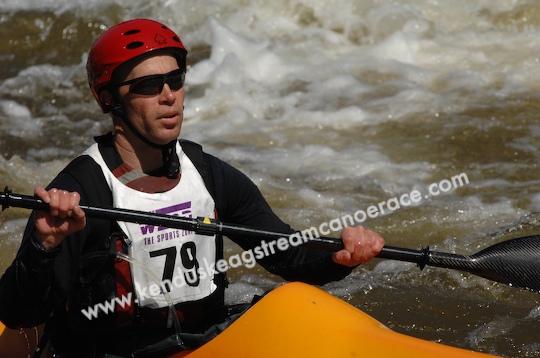
I've competed in 5-K and 10-K road races, cross country races, xc ski races, and triathlons, but I haven't found a form of racing I enjoy as much as kayak racing. I've paddled all kinds of rivers -- and raced on at least a half dozen of them, but I haven't found a river race I enjoy as much as the annual Kenduskeag Stream Canoe Race.

Part of it is the number of canoes and kayaks involved -- more than 400 on most years. Part of it is the length and difficulty of the race -- 10 miles of flatwater followed by 6.5 miles of whitewater -- made all the more difficult by fatigue. Part of it is the tradition -- the race has been around for more than 40 years now, and the returnees each year include notables such as the Gumby boat (photo) and Zip Kellogg, who wears a coat and top hat and paddles much of the race standing up.

A combined flatwater / whitewater race such as the Kenduskeag is a triathlon in itself. The first event is the 10 miles of flatwater, which tests your physical and mental stamina and your ability to get in a groove with your paddling stroke. The second event is the whitewater, a combined test of strategy, skill, and pluck. The third event (actually interpersed with the second one) is the two mandatory portages, in which competitors stagger ashore in wet gear, and labor their way through crowds of park-goers and spectators, carrying their suddenly clumsy craft through the mud.

How to survive it all. How to go fast the whole time and still leave enough to get to the finish. How to keep focus through those inevitable moments when, disoriented by fatigue, you forget you are in a race at all -- and it is just you, your boat, and that river shining under the spring sunlight.

Labels: , , ,