Waterlines: Kayaking & Paddling in Maine and Beyond

Thursday, May 08, 2008

License to Paddle

A lengthy recent discussion at Paddling.net focused on whether the idea of requiring training and licensing of paddlers is a good idea. The argument in favor of licensing holds that the number of costly rescue operations is increasing -- and that requiring paddlers to be trained and licensed would reduce the number of required rescues as well as providing a source of funds to pay for the rescues that do take place.

Those who operate powerboats over a certain length are required to have licenses, so requiring paddlers to be licensed could be seen as an expansion / extension of that law.

While I encourage kayakers to get training commensurate to the kind of paddling they will be doing, I believe that this kind of increased regulation of kayaking would would be wrongheaded, ineffective, and unenforceable.

For some, kayaking means lengthy unsupported solo night crossings between distant points of land. For others, kayaking means floating in a shallow pond on a sunny summer day, while never venturing more than 100 yards from camp. What single standardized mandatory basic safety course could possibly be helpful to each?

My point is that paddling is an incredibly varied activity -- and that no standard basic training course could effectively prepare the wide range of paddlers for the types of paddling they will be doing. At its simplest, paddling is an elemental activity that is little more sporting or dangerous than taking a walk around the block. To subject those who take a daily walk around the block to a new set of safety developed to protect mountaineers would be ridiculous. To certify prospective mountaineers with a basic safety course oriented to walkers would be equally ridiculous and falsely enabling.

The fact is that paddlers die each year because they fail to wear their life jackets, venture out on cold water without proper clothing, don't pay attention to weather conditions, or paddle in conditions above their abilities. It would be great if we could reduce the number of these deaths, but I'm not convinced that regulation is the way to get it done.

Labels: , , , ,

Friday, May 02, 2008

Some of the Best Things are Close to Home

Most of Little River in Belfast, Maine is nothing more than a shallow stream for about 355 days of the year. The other 10 days it turns into something else -- sometimes something very nice.

Heavy spring rains (2 inches within a 24 hour period) brought the river up to a fun but manageable level for paddling.

Who knew one could have that much adventure on a sunny spring afternoon -- all within 4 miles of my house and of downtown Belfast? My little trip on Little River involved a 0.7 mile drive to the put in, a scramble down a steep bank to launch, a fun half mile stretch of Class I rapids (with a tiny bit of Class II), paddling the length of Resevoir #1, a brief portage, a scramble down an extremely steep bank, a quarter mile section of Class II - III whitewater, another mile of flatwater, and then a 3 mile run along beautiful riverside trails back to my car.

Sighting: grey heron (1), beaver (2), ducks (several), other people (0). All this on an afternoon after work. Maine --- the way life should be.

Labels: , , , ,

Tuesday, April 15, 2008

Why I Love the Kenduskeag

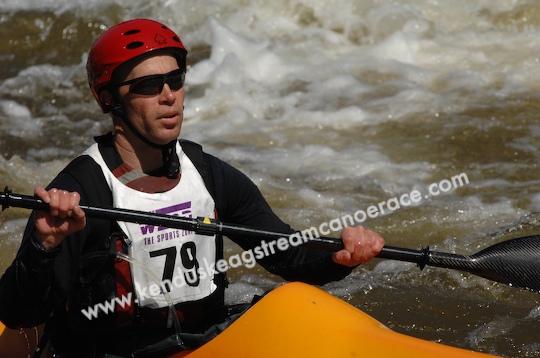
I've competed in 5-K and 10-K road races, cross country races, xc ski races, and triathlons, but I haven't found a form of racing I enjoy as much as kayak racing. I've paddled all kinds of rivers -- and raced on at least a half dozen of them, but I haven't found a river race I enjoy as much as the annual Kenduskeag Stream Canoe Race.

Part of it is the number of canoes and kayaks involved -- more than 400 on most years. Part of it is the length and difficulty of the race -- 10 miles of flatwater followed by 6.5 miles of whitewater -- made all the more difficult by fatigue. Part of it is the tradition -- the race has been around for more than 40 years now, and the returnees each year include notables such as the Gumby boat (photo) and Zip Kellogg, who wears a coat and top hat and paddles much of the race standing up.

A combined flatwater / whitewater race such as the Kenduskeag is a triathlon in itself. The first event is the 10 miles of flatwater, which tests your physical and mental stamina and your ability to get in a groove with your paddling stroke. The second event is the whitewater, a combined test of strategy, skill, and pluck. The third event (actually interpersed with the second one) is the two mandatory portages, in which competitors stagger ashore in wet gear, and labor their way through crowds of park-goers and spectators, carrying their suddenly clumsy craft through the mud.

How to survive it all. How to go fast the whole time and still leave enough to get to the finish. How to keep focus through those inevitable moments when, disoriented by fatigue, you forget you are in a race at all -- and it is just you, your boat, and that river shining under the spring sunlight.

Labels: , , ,

Tuesday, March 25, 2008

Keel Strip Alternative--Durabak


The carbon/kevlar layup of my Ruahine Swallow multisport kayak is very thin, and while I've managed to keep it off the rocks so far, it felt like I would be pushing my luck to continue to paddle it down through Class II and Class III rapids without adding a little extra protection.

A keel strip was the obvious solution. But then I read about using a rubberized truck bed coating such as Arma Coatings. Searching Paddling.net for more information on the topic, I came across a useful thread. Rather than get a commercial application, I decided to purchase a product called Durabak 18 on eBay from a company called Newlinesafety.com. The folks at Newlinesafety were very helpful in helping me chose the right product (smooth rather than textured) for this application and even warned their product would create a small amount of drag.

With that warning in mind, I decided to apply a very narrow strip in my initial application. I figure I can always go back and widen the band of Durabak as my kayak hull begins to show more wear.

Durabak can be purchased in quart sized containers. My cost, including shipping, was about $50.00. The company warns that once opened and exposed to air, the product hardens rapidly. I resealed it the best I could. If I don't get any further use out of that quart, the cost will likely be more than $1.00 per square inch. But it was easy to apply -- and if it creates some good karma as I rock'n roll my way down the river, it will have been worth it.

Sunday, March 16, 2008

Swimming the St. George

An early season "swim" is always good for helping maintain humility. Maybe I was feeling a little too confident after my clean run down the St. George on Friday.

The river level dropped about 8 - 12 inches in the last two days, which made the rapids a little more technical. And somehow (see photo above) a large log has positioned itself in an unfortunate spot, just below the drop immediately upstream from the Ghent Road bridge. As my bow nosed off the drop, it hit the submerged portion of the log, the rest of my boat swung sideways, and over I went.

So be careful out there, y'all. Scout those tricky sections even when you don't think you need to. The river is always changing.

Saturday, March 15, 2008

St. George River (Searsmont, Maine) Open!

"Oh, to have been a fly on the wall and seen the action in this valley for the last 300 years." --Zip Kellogg, Canoeing, Volume 1, Eastern & Coastal Rivers

Paddled the 6-mile section of the St. George between Searsmont and North Appleton yesterday. The river level can be described as "the high side of medium." I touched no rocks on the entire trip -- but I've definitely been on the river when the current was stronger and the standing waves were bigger.

The river is clear of ice on this entire section. Took the drop above the Ghent Road bridge on river right as usual. The drop at Magog is clear of obstructions -- and frothy enough to be a lot of fun.

Following is the description of that section from Delorme's Maine Geographic Canoeing Guide, Vol. 1:
The river remains gentle for two miles below Searsmont to Ghent or Robbin's Mill, formerly known as Dyer Mills. Saws have been cutting lumber, staves, and shingles here since the early 1800's. In the summer of 1982, the dam was removed, so scout this site carefully. The rapids just upstream of the bridge can be strong. Class II rapids continue below the bridge. The current is strong in this section of the river too, so be careful . . . be prepared to stop and scout Magog, a difficult rock-obstructed drop which may not be runnable, depending on the water level. A brick and lime kiln and quarry occupied this site many years ago. After another 1.25 miles of fairly calm waters, you'll pass under the Route 105 bridge at North Appleton.


Parking is available on the west side of the Route 105 bridge. Take out just past the bridge, along the right bank. The shuttle (or bicycle ride) is about 5 miles back to the put in.

The annual St. George River Race (on this same section of the river) is in two weeks.

Wednesday, February 27, 2008

Training for the Whitewater Race Season

The St. George River Race (Searsmont, Maine) is just 4 weeks away. Beginning this week, I'm officially in training. Today I got up off the couch, did 20 situps, and got back on the couch!
Those planning to compete in the Maine whitewater race circuit, please do not read beyond this line.

Actually, I stay pretty fit during the winter. It's all cross training, I like to believe. Shovelling my 250 foot driveway, cross country skiing, playing indoor soccer, a little bit of weight training and indoor rowing, and keeping up with my two daughters is all part of the picture. But now, with the first race 4 weeks away and the big one, the Kenduskeag, 7 weeks away, it's time to get serious. My goal is to paddle 2 - 3 days per week in the coming weeks, and to increase my workouts on my nonpaddling days as well.

Resources for training include Simon River Sports' Training Tips and a couple of Training Plans from Kayak Race.